Himalaya Exploration Tours & Travel is a registered Nepal-based agency specializing in trekking, cultural tours, and custom travel with expert local guidance and reliable service.


Upper Mustang is one of Nepal’s most fascinating and remote travel destinations, known for its ancient Tibetan culture, desert-like landscapes, and deep spiritual heritage. Tucked behind the Annapurna and Dhaulagiri ranges in the rain-shadow region of northern Nepal, Upper Mustang was once an independent kingdom and remained restricted to outsiders until the early 1990s. Today, it remains a culturally and geographically unique area, open only to limited, permitted visitors—making it a rare and exclusive Himalayan experience.
Travelers to Upper Mustang are drawn by its otherworldly scenery: wind-carved cliffs, red and ochre canyons, and stark, arid plateaus dotted with ancient monasteries, whitewashed settlements, and centuries-old cave dwellings. The capital, Lo Manthang, is a walled city rich with history, Tibetan architecture, and monastic life that feels frozen in time.
Unlike lush trekking zones, Upper Mustang’s dry terrain offers reliable travel even during the monsoon months. Whether you reach it by 4WD jeep tour or on a multi-day trek, a journey to Upper Mustang offers a deep connection to Tibetan Buddhist culture, Himalayan history, and rugged natural beauty.
It’s not just a destination—it’s a preserved world, far removed from modern influence, offering travelers a truly transformative experience.
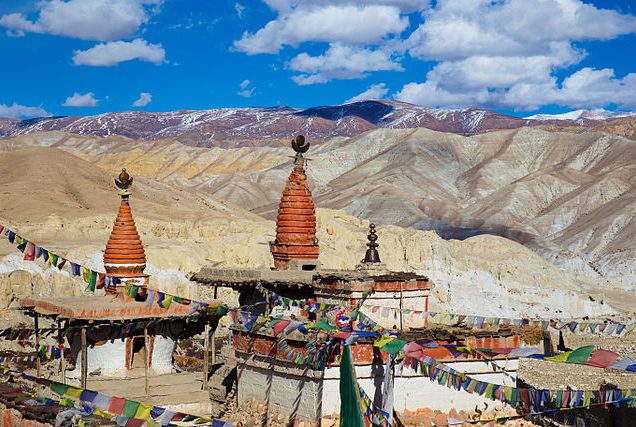
Upper Mustang lies in the northernmost part of Mustang District in Gandaki Province, bordering the Tibetan plateau. The region sits at elevations between 3,500 and 4,200 meters (11,500–13,800 ft), making it a high-altitude desert zone with dry, windy conditions year-round. Thanks to its position in the Himalayan rain shadow, it is one of the few trekking areas in Nepal that remains accessible even during the monsoon season.
The people of Upper Mustang, primarily ethnic Lobas, share deep cultural and linguistic ties with Tibet. Their traditions, architecture, and Buddhist practices remain largely unchanged due to centuries of isolation. Many villages are built with traditional flat-roofed mud-brick houses, and the use of Tibetan script, prayer wheels, and chortens is widespread. Cultural landmarks such as the ancient sky caves of Chhoser and centuries-old monasteries provide insights into pre-Buddhist and Vajrayana Buddhist practices unique to the region.
To enter Upper Mustang, travelers must obtain a special permit (USD 500 per person for 10 days) in addition to the Annapurna Conservation Area Permit (ACAP). Most treks begin with a flight to Jomsom from Pokhara, followed by a trek or jeep journey through the Lower Mustang region. Accommodations in Upper Mustang are basic but improving, with teahouses in major villages and guided tours offering support for deeper exploration. While the region is remote, it is rich in hospitality, storytelling, and visual drama that make every visit unforgettable.
Upper Mustang, often referred to as the “Last Forbidden Kingdom,” is one of Nepal’s most unique and culturally rich destinations. Nestled high in the Trans-Himalayan region, this ancient kingdom lies within the rain shadow of the Annapurna and Dhaulagiri ranges, creating a starkly beautiful desert-like landscape unlike much of Nepal’s lush green terrain. With its distinctive Tibetan-influenced culture, well-preserved medieval villages, and dramatic natural scenery, Upper Mustang offers travelers an extraordinary glimpse into a remote and largely untouched world.
The region’s history as a once-closed-off kingdom makes it a rare and prized destination. Upper Mustang remained restricted to foreign visitors until 1992, preserving a cultural and architectural heritage that appears frozen in time. Today, permits are required to visit Upper Mustang, ensuring controlled tourism that protects the fragile environment and traditional lifestyle of the local people.
Upper Mustang sits between 2,700 meters and 4,500 meters above sea level, stretching along the Kali Gandaki River valley. The region is characterized by rugged terrain, deep gorges, barren cliffs, and vast plateaus. Unlike the lush forests found in many parts of Nepal, Upper Mustang features arid, rocky landscapes punctuated by red and ochre-colored cliffs and canyons shaped by centuries of wind erosion.
The stark beauty of the region is enhanced by blue skies, golden sunlight, and vast open spaces that create a surreal atmosphere. The landscape’s harshness is softened by traditional walled villages with whitewashed houses, Buddhist monasteries, and colorful prayer flags fluttering in the breeze. The contrast between nature’s raw elements and human habitation defines the mystical appeal of Upper Mustang.
Upper Mustang’s culture is deeply rooted in Tibetan Buddhism, which shapes every aspect of local life, from festivals to daily routines. The region’s people speak a Tibetan dialect and maintain customs similar to those found in Tibet across the border. Visitors experience ancient traditions, including sacred rituals, meditation practices, and the reverence of local deities.
Lo Manthang, the walled capital of Upper Mustang, serves as the cultural heart of the region. The ancient town, founded in the 15th century, houses centuries-old monasteries, palaces, and temples decorated with intricate murals and statues. Lo Manthang’s architecture, with its flat-roofed buildings and narrow alleys, provides an authentic medieval atmosphere. The annual Tiji Festival, a three-day event celebrating the victory of good over evil, attracts locals and visitors alike with vibrant dances, music, and religious ceremonies.
Trekking in Upper Mustang is a journey into a unique environment that contrasts sharply with other popular Nepalese treks. The route traverses desert-like plateaus, dramatic cliffs, and remote villages that seem untouched by time. Trekkers are rewarded with views of snow-capped peaks including Annapurna, Dhaulagiri, and Nilgiri on clear days.
The Upper Mustang trek typically starts from Jomsom, which is accessible by a short domestic flight from Pokhara. From there, trekkers follow trails through traditional villages such as Kagbeni, Chhusang, and Ghiling before reaching the walled city of Lo Manthang. Along the way, the trail offers cultural encounters, ancient caves, chortens (Buddhist stupas), and natural hot springs.
Because Upper Mustang is in the rain shadow of the Himalayas, the region experiences minimal rainfall, making trekking feasible nearly year-round. The best time to visit is from March to May and September to November when the weather is clear, and temperatures are moderate. Winter months can be cold with snow, while the summer monsoon has little impact due to the arid climate.
Upper Mustang’s remoteness and strict permit system have helped preserve its fragile environment and cultural identity. The Nepalese government requires foreign visitors to obtain a special restricted area permit, which limits the number of tourists and ensures responsible travel practices. This controlled tourism helps protect traditional lifestyles and reduces environmental impact.
Local communities rely heavily on trekking tourism for income, which has encouraged sustainable tourism initiatives. Many villages have implemented waste management programs, and trekking agencies work closely with local guides and porters to maintain respectful and eco-friendly tourism standards.
Accommodation options in Upper Mustang are basic but comfortable, with teahouses and guesthouses available in major villages and towns along the trekking route. Facilities may be rustic compared to those in more popular trekking regions, but the warmth and hospitality of the local people compensate for the simplicity. Meals often include traditional Tibetan and Nepali dishes, providing nourishing fare for travelers after long days on the trail.
Electricity and internet access are limited but improving, primarily available in larger villages such as Lo Manthang and Jomsom. Travelers should be prepared for modest amenities and embrace the opportunity to disconnect and immerse themselves fully in the remote mountain environment.
Lo Manthang: The walled city is the cultural and spiritual center of Upper Mustang, offering rare insights into medieval Tibetan life with its ancient architecture and vibrant festivals.
Tiji Festival: Held annually in Lo Manthang, this festival celebrates the triumph of good over evil through colorful masked dances and religious rituals, a highlight for cultural travelers.
Caves and Chortens: Scattered throughout the region, these ancient Buddhist sites are mysterious and fascinating, used historically by monks for meditation and spiritual retreats.
Desert Landscapes: The striking barren cliffs and canyons create an otherworldly backdrop for trekking and photography, contrasting with the green valleys typical of Nepal.
Upper Mustang offers a rare opportunity to explore a culturally intact and geographically unique region of Nepal. It appeals to adventurous travelers seeking:
A remote and off-the-beaten-path experience with limited tourist crowds.
Immersion in Tibetan Buddhist culture and ancient traditions.
Dramatic, desert-like landscapes and Himalayan vistas.
Well-preserved medieval architecture and spiritual sites.
An accessible trekking route that is less affected by monsoon weather.
Upper Mustang remains one of Nepal’s most compelling destinations for travelers seeking authentic cultural encounters and striking natural beauty in a remote Himalayan environment. Its unique landscape, rich Tibetan heritage, and controlled tourism policies make it a must-visit region for those looking to venture beyond Nepal’s popular trekking circuits. With careful planning, respect for local customs, and a spirit of adventure, visitors to Upper Mustang will discover an unforgettable mountain kingdom that feels timeless and extraordinary.

This will close in 20 seconds